The Next Frontier of Railway Safety: How the Apollo Framework Transforms Track Maintenance
A Network on the Edge
Across North America, aging railway infrastructure is straining under heavier loads and harsher climates. According to the Association of American Railroads (2022), a nationwide rail service interruption could cost the U.S. economy more than US $2 billion per day, underscoring how dependent national productivity is on uninterrupted rail operations.
In Canada, extreme weather disruptions are becoming a major economic burden, with damage to roads and railways projected to reach C$5.4 billion annually by mid-century, according to the Canadian Climate Institute.
For operators like CN, CP, and TTC, every minute of downtime translates into lost revenue, logistical disruption, and reputational risk.
The challenge isn't just fixing what breaks — it's foreseeing what will.
Why Traditional Maintenance No Longer Works
Track inspections today are still largely manual, periodic, and siloed. A visual inspection every few years can miss early-stage subsidence or ballast instability. Data from LiDAR, GPR, and climate sensors often lives in separate silos, making correlation and insight generation difficult.
As a result, many defects are detected too late, forcing unplanned shutdowns and emergency repairs that cost up to 4× more than planned interventions. Operators increasingly recognize the need for a unified, data-driven system that continuously tracks, analyzes, and alerts.
What the Industry Is Demanding
Rail operators across North America are calling for a decisive shift from reactive maintenance to autonomous, data-driven inspection. They need systems that not only detect faults but interpret conditions in real time and guide timely decisions within active operations.
This transformation also demands built-in climate resilience. With rising threats from flooding, frost heave, vegetation growth, and permafrost stress, operators require tools that adapt to changing environments rather than react to failures.
The push is clear: Amtrak is moving toward condition-based maintenance but admits predictive analytics remain limited. TTC has made state-of-good-repair its top capital priority, while CN generates millions of inspection data points that still depend on manual interpretation
Without automation, these insights remain underused—and risk turning into missed warnings.
Industry consensus is clear: the next leap forward lies in AI-enabled inspection and predictive analytics that transform data into foresight. As Deloitte (2024) reports, improving infrastructure resilience with AI could prevent up to 15% of global infrastructure losses, equating to nearly US $70 billion in annual savings.
The race to predictive resilience is no longer optional—it's essential.
The Apollo Framework: Railway Infrastructure Monitoring Framework
ApoSys's Apollo Framework addresses these industry demands while acknowledging that full forecasting is a longer path ahead. At present we deliver:
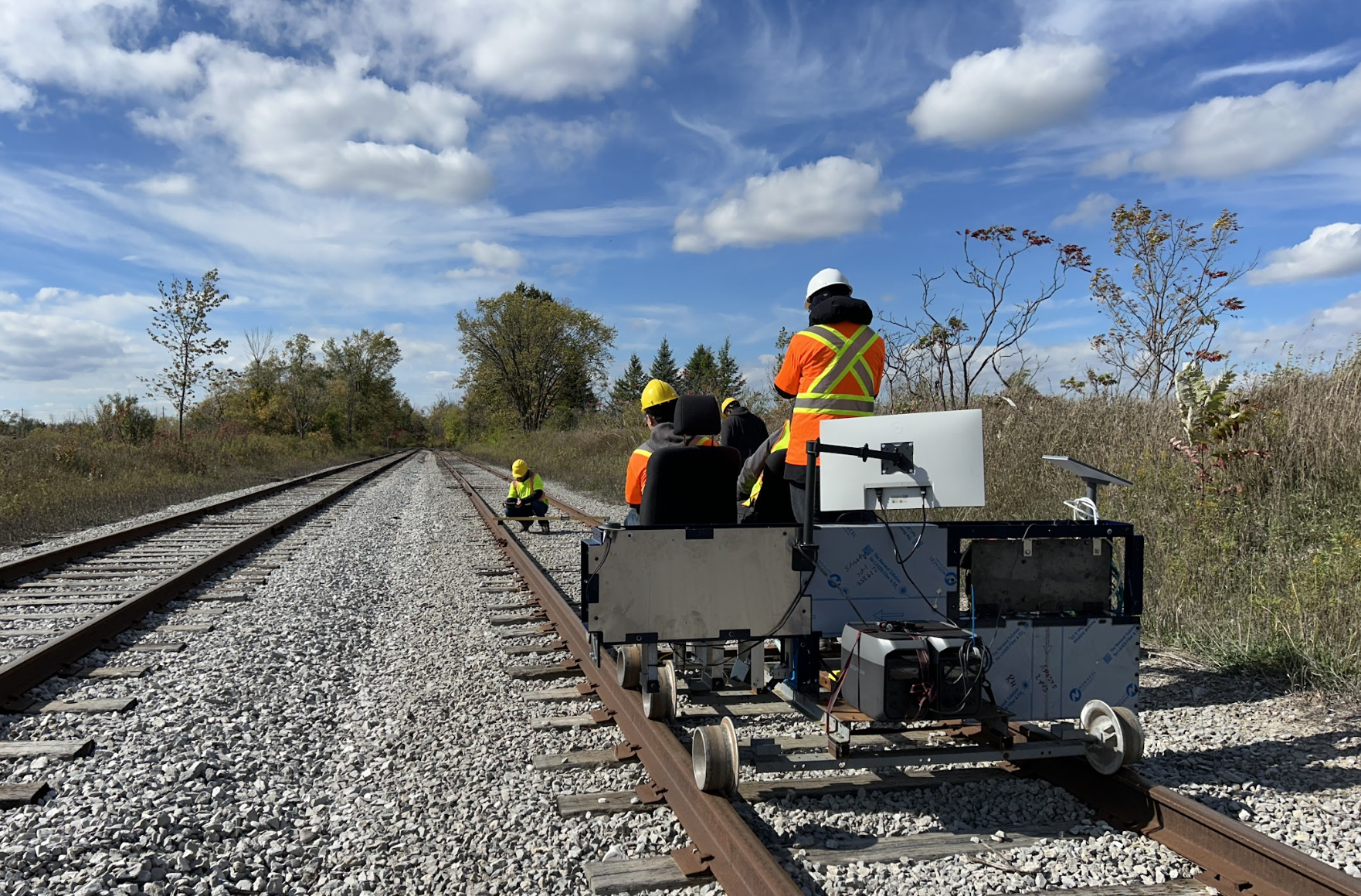
- Apollo Sense™, also known as the Autonomous Track Monitoring Unit (ATMU), for onboard autonomous sensing via LiDAR, GPR, and imaging.
- Apollo Cloud™, AI/ML engine for data reduction, anomaly detection, and predictive modeling.
- Apollo Dashboard™, a geospatial visualization hub linking live, historical, and environmental records.
Together, they create a digital twin—and in advanced deployments, a digital triplet—of the entire network, enabling planners to simulate degradation, optimize budgets, and prevent failures before they occur.
The Apollo Framework operates end-to-end, continuously tracking, analyzing, and alerting to provide a unified, data-driven view of infrastructure health.
From Reactive to Predictive: Apollo in Action
In deployments with Hudson Bay Railway, ApoSys demonstrated how autonomous, continuous monitoring can significantly reduce reliance on the traditional five-year inspection cycle, paving the way toward predictive, real-time asset management.
Mounted ATMU units collected LiDAR, GPR, and thermal data without breaking operations, surfacing defects invisible to the naked eye. These deployments achieved:
-
5× increase in inspection coverage
-
80% reduction in engineering review time
-
Up to 40% decrease in emergency repair spending
Audit and compliance processes were streamlined through exportable, digital inspection reports.
Smart Resilience for a Changing Climate
Rail corridors in northern Canada and around the Great Lakes face growing risk from permafrost thaw, freeze-thaw cycles, and flooding. Warming of ground ice undermines soil strength, causing gradual deformation and settlement.
The Apollo Framework is designed to incorporate satellite deformation mapping and weather nowcasts to alert operators when subgrade moisture or thermal gradients approach danger thresholds.
Building on this capability, ApoSys is advancing toward an integrated predictive system that correlates hydrology, soil behavior, and traffic loads to forecast potential weak points — helping operators act before slow orders or track failures occur.
A Transit Network Case in Point: TTC
Toronto's transit network faces increasing maintenance pressure as many of its rail assets age. ApoSys's Apollo sensing model can enable continuous scanning of tunnels and surface tracks without disrupting service windows. Detected signal anomalies would be processed through an AI-driven risk dashboard, giving TTC's engineering teams the ability to prioritize interventions where they matter most — rather than reacting to failures or waiting for scheduled inspections.
Economic and Environmental ROI
Beyond safety, Apollo delivers measurable returns. Automation can cut inspection costs by up to 60%. Targeted interventions extend asset life. The system also reduces carbon footprints by minimizing manual patrols and heavy-machinery deployment.
Furthermore, the data-driven approach supports ESG goals and investor reporting by quantifying infrastructure health over time.
The Way Forward
Many North American rail operators stand at a crossroads: modernize or lose operational resilience. The Apollo Framework provides a bridge — enabling today's operators to shift from periodic inspections to continuous monitoring, and toward tomorrow's vision: true prediction.
For CN, CP, TTC, or Amtrak, Apollo is the foundation for rail modernization — where downtime is anticipated, not feared, and infrastructure becomes an intelligent network rather than a collection of risks.